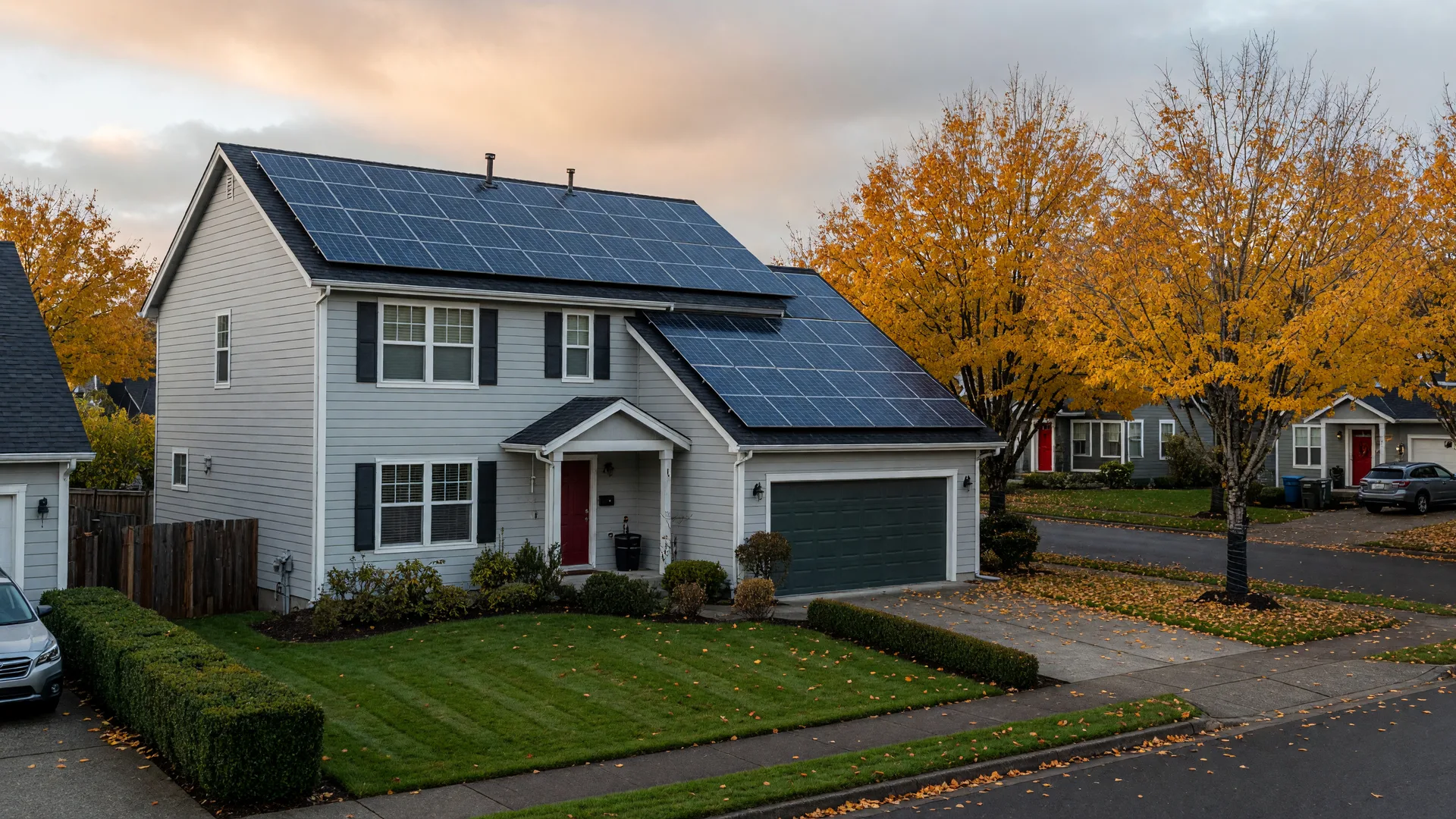
Solar homes in Tualatin: what buyers should know.
More Tualatin homes are coming to market with rooftop solar, and the terms matter as much as the panels. Here is what Oregon buyers should know about rebates, net metering, and the lease-versus-owned question, and how the 2025 system at 22379 SW 107th Ave is set up.
Solar is no longer a rare sight on Tualatin rooftops. Between Oregon's state incentives, utility net metering, and a property tax exemption for qualifying systems, the math has made panels a practical upgrade for many homeowners. For buyers, the key is understanding how a system is financed, because that decides who owns it, who keeps the savings, and how smoothly it transfers at closing.
The home at 22379 SW 107th Ave is a good case study. A high-capacity solar photovoltaic system was installed in 2025, with an estimated annual production of 16,424 kWh. The average Oregon home uses roughly 10,000 to 12,000 kWh per year, so the system is sized to cover a typical household's usage and then some, which is what makes the details of the arrangement worth understanding.
The incentives
What Oregon offers solar homeowners.
Oregon Solar + Storage Rebate
State program, Oregon Department of Energy
The state's Solar + Storage Rebate Program offers homeowners up to $5,000 for a solar electric system and up to $2,500 for battery storage, calculated at about $0.20 per watt DC. Higher amounts are available to low- and moderate-income households, and the program is a major reason panels keep showing up on Tualatin roofs.
Energy Trust of Oregon incentives
Cash incentives for PGE and Pacific Power customers
Energy Trust of Oregon offers cash incentives that reduce the up-front cost of solar for customers of Portland General Electric and Pacific Power. Adding battery storage can trigger a separate incentive, which is worth knowing if you are shopping for a home that already has panels and considering a battery later.
Net metering
1:1 retail credit on your utility bill
Oregon's net metering rules give PGE and Pacific Power customers a 1:1 retail credit for excess power their system sends back to the grid, for home systems up to 25 kW. On sunny summer days, a well-sized system can build a credit that offsets the darker winter months.
Property tax exemption
ORS 307.175
Under Oregon law, the added home value from a qualifying alternative energy system is exempt from property taxes. A solar upgrade that increases a home's assessed value does not push your tax bill up with it, which keeps the savings on the energy side rather than giving them back in taxes.
The fine print
Owned versus leased: the question that matters at closing.
Before you fall in love with a solar home, find out who owns the system. It changes everything about the deal.
Owned systems
Paid in cash or financed with a loan
An owned system is the simplest to transfer at sale. The buyer keeps the energy savings and any remaining incentives, and research from the National Renewable Energy Laboratory has shown owned solar generally increases a home's resale value. No third party to satisfy, no lease payments to assume, no credit check to pass.
Leased systems and PPAs
Third-party owned
With a lease or power purchase agreement, a solar company owns the panels. The buyer must pass the leasing company's credit check to assume the lease, or the seller must buy out the contract before closing, which can slow the sale and shrink the pool of interested buyers. Leases often include annual payment escalators of 1 to 3 percent over 20- to 25-year terms, and the tax credits go to the leasing company, not the homeowner. Energy Trust of Oregon advises proceeding cautiously and reading the full terms.
At 22379 SW 107th Ave
How this home answers the solar question.
The solar system at 22379 SW 107th Ave was installed in 2025 and is leased, but the seller is paying off the lease at closing. That means the buyer takes ownership of a fully paid system, with the panels, the production, and the savings free of any lease payments or third-party contracts. It is the outcome most buyers hope for when they see panels on a roof, and it removes the biggest complication solar homes can carry.
Pair the solar with the home's other 2020s upgrades, the 2025 roof replacement, the high-efficiency dual-zone HVAC with smart thermostat, and the 2023 water heater, and you get a picture of a house where the big-ticket systems have already been handled. For buyers comparing Tualatin homes, that is exactly the kind of detail worth asking about on every tour.
Make Your Move
Ask the solar questions before you make an offer.
Whether you are looking at 22379 SW 107th Ave or any other Tualatin home with panels, Paul Knighton of MORE Realty can walk you through the system, the lease, and the numbers before you commit.
Schedule a Tour